
WhatsApp Business API pricing explained
Since 1 July 2025 Meta charges the WhatsApp Business API per delivered message, with rates that depend on the message category, the recipient's country and your monthly volume. On 1 October 2026 the last free lanes closed: replies inside the 24-hour window and utility messages inside it are now billed too. Here are the current USD rates and what they mean for a store.
By Mousa Alhelo, founder, E-SAFQA · Updated · 11 min read · How we write and test these guides

The model: per message, by category, by country
Meta's pricing page states that from 1 July 2025 the WhatsApp Business Platform moved from conversation-based pricing to per-message pricing: you are charged only when a template message is delivered. There are four template categories. Marketing messages are always charged. Since 1 October 2026 utility, authentication and service messages are charged too, including inside an open customer service window; before that date, utility templates inside the window and service replies were free.
Rates vary by the recipient's country calling code. Meta lists individual rates for large markets such as India, Brazil and Mexico, and regional buckets such as Rest of Africa and Other for everyone else. The exact numbers change, so always read the live rate card on developers.facebook.com before budgeting.
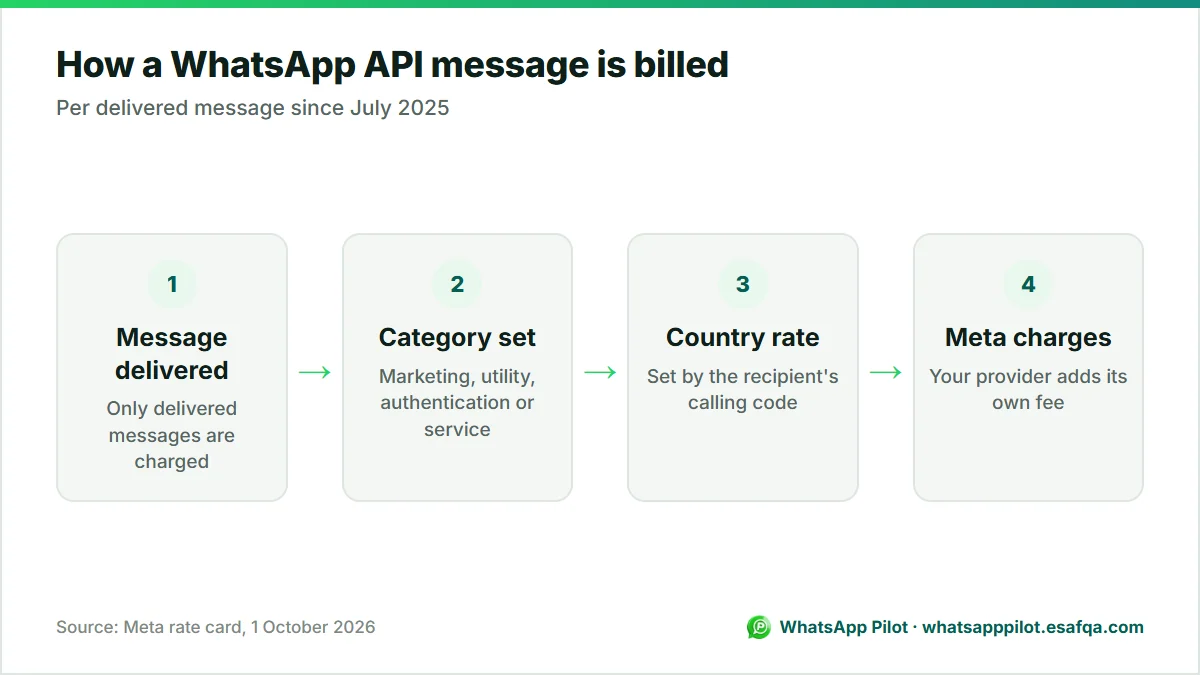
How Meta's rate card is organised
Meta does not print rates on the pricing page itself. It publishes downloadable rate cards: a rates file, a volume-tiers file and a combined PDF, in 16 billing currencies (USD, AED, ARS, AUD, BRL, CLP, COP, EUR, GBP, IDR, INR, MXN, MYR, PEN, SAR, SGD). As checked on 8 October 2026, the downloadable USD card is dated 1 October 2026; rates can change on 1 January, 1 April, 1 July and 1 October, so always download the card on the day you budget.
Thirty markets have their own rates: Argentina, Brazil, Chile, Colombia, Egypt, France, Germany, Hong Kong, Hungary, India, Indonesia, Israel, Italy, Malaysia, Mexico, Netherlands, Nigeria, Pakistan, Peru, Poland, Qatar, Romania, Russia, Saudi Arabia, Singapore, South Africa, Spain, Turkey, United Arab Emirates, United Kingdom. Every other country falls into a regional group: North America, Rest of Africa, Rest of Asia Pacific, Rest of Central and Eastern Europe, Rest of Western Europe, Rest of Latin America, Rest of Middle East, or Other.
- The rate that applies is the one for the recipient's country calling code, not your store's country.
- A store in Jordan selling to Saudi Arabia and the UAE pays those two markets' rates; recipients in Jordan, which has no rate of its own, are billed at their regional group rate.
- Your billing currency is fixed by your WhatsApp Business Account, and the rate date follows that account's time zone.
How to estimate your monthly API bill
- Export last month's orders by shipping country from Shopify.
- Count the messages per order you plan to send: for example one confirmation (utility) and, for abandoned checkouts, up to three reminders (marketing).
- Download the current rate card in your billing currency and look up the utility and marketing rate for each country or region.
- Multiply messages by rate per country and add them up, or enter the totals in our free WhatsApp API cost calculator at /tools/whatsapp-api-cost-calculator.
- Add your provider's monthly platform fee and any per-message markup. Compare the total with a flat-price linked-device app.
Meta's USD rates by country, effective 1 October 2026
The table lists Meta's list rates per delivered message in USD from the rate card dated 1 October 2026 (tier 1, before volume discounts). The rate is set by the recipient's country calling code. Utility, authentication and service messages share one rate in every market.
- Example: 1,000 order confirmations to Saudi numbers cost about $10.70 in utility fees; 1,000 abandoned-checkout reminders to the same numbers cost about $57.60 in marketing fees, before any provider fee.
- Jordan has no standalone rate; recipients with a +962 number are billed at the Rest of Middle East rate.
- Meta can change rates on 1 January, 1 April, 1 July and 1 October with one month's notice, so check the rate card before you budget.
| Recipient market | Marketing | Utility / Service |
|---|---|---|
| United States and Canada | $0.0250 | $0.0034 |
| United Kingdom | $0.0635 | $0.0220 |
| India | $0.0118 | $0.0014 |
| Brazil | $0.0625 | $0.0068 |
| Mexico | $0.0397 | $0.0085 |
| Argentina | $0.0618 | $0.0260 |
| Colombia | $0.0125 | $0.0008 |
| Spain | $0.0707 | $0.0200 |
| France | $0.0859 | $0.0300 |
| Germany | $0.1365 | $0.0550 |
| Saudi Arabia | $0.0576 | $0.0107 |
| United Arab Emirates | $0.0576 | $0.0157 |
| Egypt | $0.0644 | $0.0036 |
| Kuwait | $0.0792 | $0.0440 |
| Qatar | $0.0341 | $0.0120 |
| Morocco | $0.0414 | $0.0230 |
| Turkey | $0.0109 | $0.0009 |
| Indonesia | $0.0411 | $0.0250 |
| Nigeria | $0.0516 | $0.0067 |
| Pakistan | $0.0473 | $0.0150 |
| Rest of Middle East (includes Jordan) | $0.0392 | $0.0091 |
| Rest of Africa | $0.0225 | $0.0040 |
| Rest of Latin America | $0.0740 | $0.0113 |
| Rest of Asia Pacific | $0.0842 | $0.0113 |
| Rest of Western Europe | $0.0592 | $0.0171 |
| Rest of Central and Eastern Europe | $0.0860 | $0.0212 |
| Other | $0.0604 | $0.0077 |
What changed on 1 October 2026
Until 30 September 2026 two kinds of messages were free: replies you sent inside the 24-hour customer service window that opens when a customer messages you, and utility templates delivered inside that window. Meta's non-template pricing page states that from 1 October 2026 both are charged per message at the market's utility rate. Service messages have no volume tiers.
- Free entry point conversations are unchanged: reply within 24 hours to a chat that started from a Click-to-WhatsApp ad or a Facebook Page button and that reply is free, opening a 72-hour window in which message delivery is not charged.
- Only one charge applies per message; a reply is never billed twice.
- Meta Business Agent (AI replies) is billed separately per token since 1 August 2026.
Volume tiers
Meta documents that lower utility and authentication rates unlock as your monthly message volume grows. Tiers reset every month and are counted across all WhatsApp Business Accounts in your business portfolio. Marketing messages do not get volume discounts.
The part the rate card does not show: provider fees
Almost every store uses the API through a Business Solution Provider (BSP) or a SaaS app built on the Cloud API. Those vendors charge a monthly platform fee, sometimes a markup per message, and often a minimum plan. When you compare apps, add three lines: Meta's per-message rate for your customers' countries, the provider's platform fee, and any per-message markup.
Worked example for a Shopify store
| Message | Category on the API | Charged? |
|---|---|---|
| Order confirmation right after checkout | Utility template | Yes, at the utility rate |
| Abandoned-checkout reminder with a discount | Marketing template | Yes, at the marketing rate |
| Reply to a customer question | Service message | Yes since October 2026, at the utility rate |
| One-time passcode | Authentication template | Yes, at the authentication rate |
When a Shopify store does not need the API
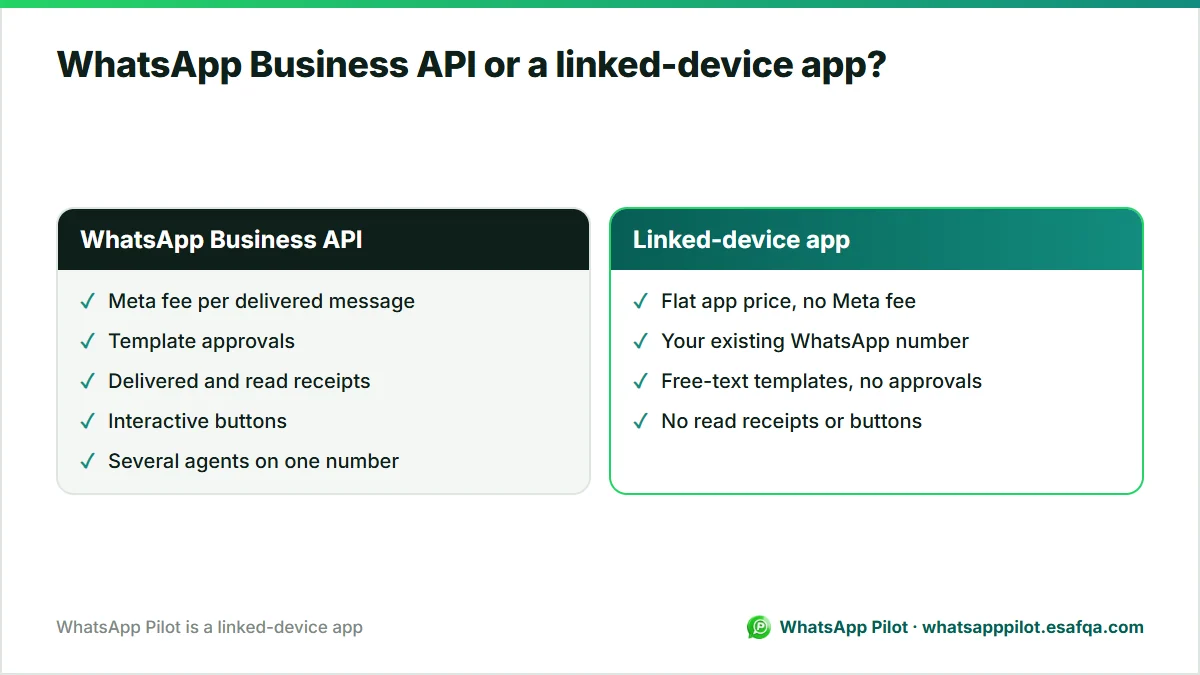
If you send a modest volume of transactional messages from one store and you already own a WhatsApp number, a linked-device app does the same job without Meta per-message fees, template approvals or a BSP account. WhatsApp Pilot works that way: it links your number like WhatsApp Web and sends order confirmations and consent-based recovery reminders from it, for a flat Pro price. The trade-offs are real and documented on our connection page: no delivered or read receipts, no interactive buttons, and the usual WhatsApp account rules apply to your number.
If you run high-volume campaigns, need template approvals, read receipts or several agents on one number, the API is the right tool and its pricing is the cost of that capability.
Frequently asked questions
Is the WhatsApp Business API free?
No. Meta charges per delivered message in every category, and since 1 October 2026 replies inside the 24-hour window are charged as well. Only the 72-hour free entry point window after a Click-to-WhatsApp ad is free. Providers add their own fees.
How much does WhatsApp API cost in India?
On the rate card effective 1 October 2026, a marketing message to an Indian number is $0.0118 and a utility, authentication or service message is $0.0014, before volume tiers and provider fees.
How much does WhatsApp API cost in Saudi Arabia and the UAE?
Marketing is $0.0576 in both. Utility, authentication and service messages are $0.0107 in Saudi Arabia and $0.0157 in the UAE (rate card effective 1 October 2026).
Does WhatsApp Pilot charge per message?
No. WhatsApp Pilot has a Free plan and a flat Pro plan. It does not use the API, so there are no Meta per-message charges from the app.
Where do I find current API rates for my country?
On Meta's WhatsApp Business Platform pricing page, which lists rates by country calling code and category.
Ready to put WhatsApp to work on your store?
Start with the free widget. Upgrade to Pro for order messages, cart recovery, the smart product button, back-in-stock alerts and Product Demand.